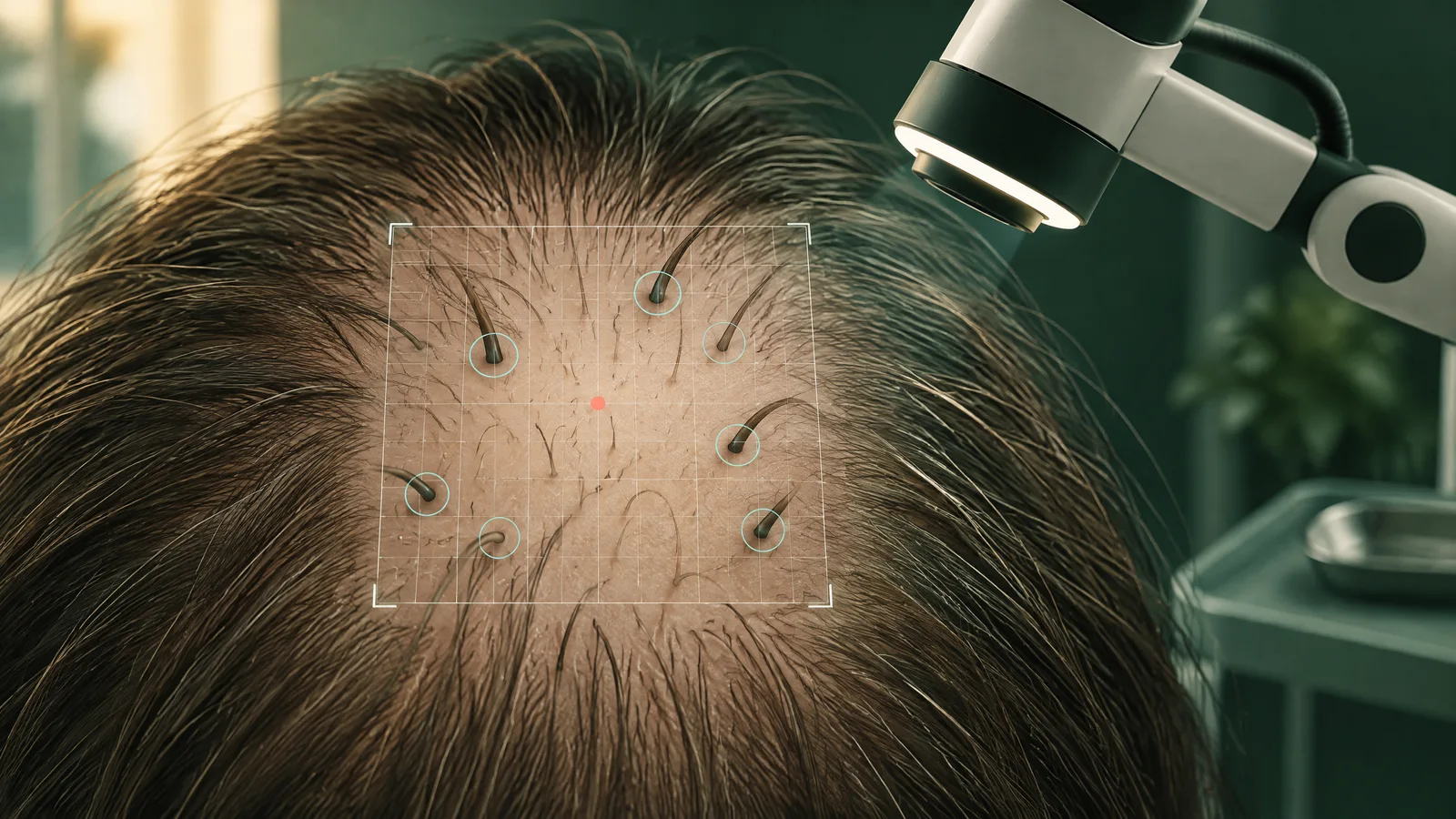
Veradermics, a New Haven, Connecticut, drug developer listed on the New York Stock Exchange, reported on October 19, 2026 that its experimental tablet VDPHL01 met all primary and secondary endpoints in the placebo-controlled part of a Phase 3 trial in men with pattern hair loss1. VDPHL01 is an extended-release formulation of minoxidil, the drug long sold as the topical product Rogaine and, as a tablet, approved for high blood pressure13. The figures come from a company announcement filed with US securities regulators. They have not been published in a peer-reviewed journal.
What was announced
The trial, called Study 304, enrolled 536 men who were randomly assigned to one of three groups: 8.5 mg of VDPHL01 once daily, 8.5 mg twice daily, or placebo1. The trial registry describes a randomized, parallel-group study with participants, care providers, investigators and outcome assessors all blinded, in men aged 18 to 65 with mild to moderate androgenetic alopecia, at 44 listed sites in the United States2.
Each trial in the program uses a 52-week design: six months against placebo, followed by six months in which all participants receive VDPHL011. The October announcement covers only the first, placebo-controlled half, which the company calls Part A1.
The two co-primary endpoints were measured at month 6. The first was the change from baseline in non-vellus target area hair count, a count of thicker, pigmented hairs as distinct from fine vellus hairs, in a defined patch of scalp15. Participants had to agree to a micro-dot tattoo marking that area and to have it photographed at study visits2. The second was the share of participants who rated their hair coverage as “improved” or “much improved” on the Androgenetic Alopecia Impact Rating Scale (AAIRS), a patient-reported measure the company describes as proprietary1.
The numbers reported
The company released these month-6 results1:
| Measure at month 6 | 8.5 mg once daily | 8.5 mg twice daily | Placebo |
|---|---|---|---|
| Mean increase in non-vellus hair count | 28.6 hairs/cm² | 36.4 hairs/cm² | 6.6 hairs/cm² |
| “Improved” or “much improved” on AAIRS | 55.7% | 68.7% | 15.0% |
| Any reported improvement on AAIRS | 78.8% | 85.0% | 35.3% |
| Improved coverage, investigator rating (IGA) | 78.4% | 82.7% | not given |
Veradermics reported p-values below 0.0001 for both doses against placebo on the co-primary endpoints1. It said the active groups separated from placebo on hair count, the patient scale and the investigator assessment at month 2, the earliest time point measured1.
The results resemble those the company reported in April 2026 from Part A of Study 302, a Phase 2/3 trial in 519 men. There, hair counts rose by 30.3 and 33.0 hairs/cm² on the once-daily and twice-daily doses versus 7.3 on placebo, and 48.4% and 62.9% rated their coverage improved or much improved versus 13.4% on placebo1. Veradermics says the two studies together provide six-month placebo-controlled data on more than 1,000 men1.

Side effects reported
The company said there were no treatment-related serious adverse events and no adverse events of special interest of cardiac origin1. Two side effects passed a 5% threshold in either Study 304 or Study 302. In Study 304, peripheral edema (swelling, usually of the legs or ankles) occurred in 2.8% of the once-daily group, 4.5% of the twice-daily group and 0.6% on placebo. Hypertrichosis, extra hair growth elsewhere on the body, occurred in 2.2%, 9.0% and 0% respectively1. Each of those two effects led 0.6% of the twice-daily group, and nobody in the once-daily group, to leave the study1. Gizmodo reported that fewer than 1% of people in either treatment group stopped the drug because of these or any other adverse event3.
These safety figures describe a selected group. The registry lists exclusions for uncontrolled blood pressure, orthostatic hypotension, certain heart or thyroid conditions, and recent dietary or weight changes, including use of GLP-1 drugs2.
What the data do not show yet
- Peer review and full data. The release gives topline numbers; detailed results by baseline severity, age or dropout have not been made public.
- A comparison with generic oral minoxidil. Dermatologists already prescribe low-dose immediate-release minoxidil tablets off-label for hair loss3. Veradermics has not tested its pill head to head against that cheaper option, so how much it adds over generic minoxidil is unknown5.
- Longer-term results. The data cover six months. Twelve-month safety data from Part B of Study 302 are expected later this year1.
- Women. Study 304 enrolled only men. A separate trial in women has not read out1.
- Approval. VDPHL01 is not approved by the US Food and Drug Administration for pattern hair loss, and approval remains uncertain4.
Who is behind it
Veradermics calls itself a dermatologist-founded, late clinical-stage company focused on pattern hair loss; VDPHL01 is its lead program1. Its filing notes that it has no products approved for sale, has had substantial losses since its start and depends on VDPHL01 gaining approval1. The company says the drug is covered by patents and applications, the earliest expiring in 20431. Its shares rose more than 11% during trading on the day of the announcement5.
“Based on these results, we believe VDPHL01 has the potential to transform the treatment of pattern hair loss for millions of people.” Reid Waldman, M.D., chief executive of Veradermics1
The release also quotes Antonella Tosti, a dermatology professor at the University of Miami, who said the consistency across Studies 302 and 304 gave her confidence in the results and that VDPHL01 could become a new standard of care for male pattern hair loss “if approved”1. The release does not describe whether she has a financial or advisory relationship with the company. On price, Gizmodo reported that the company has pointed to Nutrafol, a supplement selling for about $90 a month, as a benchmark3.
How it fits the field
Veradermics states that no new FDA-approved prescription medicine for pattern hair loss has appeared in nearly 30 years1. Topical minoxidil can irritate the scalp, some users find a daily gel or foam hard to keep up, and it is toxic to cats and dogs; in recent years dermatologists have started prescribing very low-dose oral minoxidil instead3. The company’s central claim is that its gel-matrix tablet avoids the high peak blood levels of immediate-release minoxidil while keeping levels above a hair-growth threshold for longer1. That is a design rationale stated by the company; the topline release does not include blood-level data from Study 304.
Other candidates are moving through trials. Cosmo Pharmaceuticals’ topical clascoterone 5% solution has reported two Phase 3 trials in a combined 1,465 patients, with marketing applications under way in the US and EU, according to BigGo Finance5. The same report said Pelage Pharmaceuticals enrolled the first patient in a Phase 2/3 trial of its topical PP405 in October, and that Eli Lilly has invested in two hair-loss drug developers, Amplifica and Absci5. Professional guidance elsewhere has been cautious about oral minoxidil: the Japanese Dermatological Association’s 2017 guideline graded it D, meaning it should not be performed, citing the lack of approval for hair loss and unverified systemic risks5.

What to watch next
- Study 302 Part B, with safety data out to 12 months, which the company expects later in 20261.
- Study 306, a Phase 2/3 trial of 4.5 mg once and twice daily in 556 women, with topline data expected in the first half of 20271.
- Study 304’s extension phase, in which all participants receive the drug; the registry estimates primary completion in December 2026 and study completion in July 20272.
- A filing with the FDA and full publication of the trial data. The October release does not give a date for either1.